

Unreleased Talks
These are talks from previous Polyglot Conferences both online at Global and in-person. You get to see them before anyone else during the Polyglot Conference Global event each year!

A Tonal Map of Asia: Building Cross-Language Tools That Can Help Preserve and Teach Endangered and Mainstream Tonal Languages (LIVE)
This presentation introduces a system designed to support the preservation and practical teaching of tonal and script-based languages, including many under-documented Tai varieties. Built on over two decades of linguistic training and field experience, Cracking Language Fundamentals (CLF) is a modular, AI-enabled framework that visualises and compares tonal structures across Thai, Lao, Vietnamese, Chinese, and over 300 Tai datasets.
These datasets—many contributed by linguists such as Dr Rikker Dockum and others—are now being used not just to document languages, but to actively reintroduce core tonal logic to native speakers. The tools in the system map tonal contours, classify syllable types, and show how the rules in these languages correspond to shared structures rooted in Sanskrit and Indic systems.
The platform connects Thai’s tone-class logic to 平上去入 in Chinese and Vietnamese, reveals how Hangul’s design stems from Phagspa and Brahmi, and integrates the historical Qieyun phonological system used in Chinese character dictionaries.
CLF is also used to revive lost literacy. The Khom script—once used to write Thai, now mostly seen on temple walls—has become readable again for many native speakers using these tools.
This session will present the structure of the system, the methodology behind its development, and how it enables both preservation and use. It is designed not just for researchers, but for communities reclaiming their own linguistic systems, and for educators looking to make tonal and abugida-based languages teachable again—without dumbing them down or stripping them of their native logic.
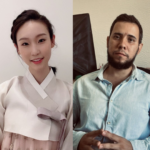
Language Exchange: Mastering Learning Through Meaningful Interaction. (LIVE)
In this presentation, we will share the unique experience of our language exchange journey between Korean and Portuguese. Together with my friend Judy Um, we will walk you through the proven methods and practical strategies that helped us progress as learners.
Language exchange is more than just practicing vocabulary; it’s about fostering real, meaningful interactions that accelerate learning. We’ll cover the importance of consistency in practice, how to balance speaking and listening, and tips on making the most of your time with a language partner. Judy and I will share specific techniques for overcoming challenges in pronunciation, grammar, and cultural differences that often arise during the process.
You’ll also learn how to structure your language exchange sessions, how to stay motivated throughout the process, and how to integrate language learning into your daily life. We will discuss the importance of patience and setting realistic goals, as well as how to embrace mistakes as valuable learning opportunities.
By the end of this talk, you’ll walk away with actionable tools and insights that will help you build a more effective and enjoyable language exchange routine, whether you’re just starting or looking to level up your skills.

Leyendas Urbanas Panamá (LIVE WORKSHOP)
Join us to practice Spanish in a welcoming space open to all cultures. Together, we will share and discuss the urban legends we grew up with, blending language learning with a touch of mystery and culture. This will be a safe and inclusive space to practice your Spanish. If you are from Latin America, I would love to hear your stories and explore how much we have in common!

Building and Guiding r/languagelearning: From Small Forum to Global Community (LIVE)
Simon, the lead moderator of the r/languagelearning community on Reddit, shares the story of how the subreddit grew from a small forum into a thriving global hub for language learners. He will discuss the challenges and strategies behind moderating such a large community, the goals of the subreddit, and the work that goes into keeping it useful for learners worldwide. Simon will also present the evolution of the subreddit’s language learning guide—how it was designed, who it is aimed at, and how it grew from a simple wiki entry into a full ebook. The talk concludes with a Q&A session.

Ryukyuan: The Forgotten Japonic Languages (LIVE)
People often see Japanese as a language isolate, not a part of any large family like Romance, Germanic, Slavic, or Semitic. And yet, the truth is that Japanese does indeed belong to a family – the Japonic language family. The only other members of this family are the languages of the Ryukyu islands, known as Ryukyuan. To this family belong Okinawan, Kunigami, Amami, Kikai, Okinoerabu, Yoron, Yaeyama, and many others. The reason why these languages are obscure is that the Japanese empire enforced the use of Japanese in all spheres of life, leading to a severe decline in their use in the 19th and 20th centuries. Though the situation has improved since then, the languages are still considered endangered, but revival efforts, especially for Okinawan, are underway.
In this talk you will learn about the diversity, distribution, and history of the Ryukyu languages and the peoples that speak them. We will look at how these languages diverged from Old Japanese and how they simultaneously closely parallel standard Japanese, and subvert many expectations that people have about this language: creative use of Kana, pronoun use, verbal conjugation, what counts as a vowel and much more!

Are Digital and AI-powered Tools Time-wasters or Time-savers in Teaching and Learning Languages? (LIVE)
This presentation aims to show how digital and AI-powered tools can be used by educators and learners in the ESL classroom: adapting digital tools to meet learners’ and educators’ needs and the ways interactive virtual boards can be applied to promote 21st century skills. Nowadays students have become more technology-addicted and less motivated to study. Teenagers spend a lot of time creating different content using AI-powered tools as well as doing their homework with the help of generative AI. What can teachers do to break these bad habits? The answer is to use technology and AI tools to learners’ advantage.
We will share different ways of effective incorporation of AI-powered tools in teaching for creating various materials for language classes. We also recommend applying interactive virtual boards activities in teaching and learning processes as one of the crucial suggestions. Using interactive virtual boards will definitely motivate and involve students to participate in productive activities. It is an incredibly helpful tool for developing 21st century learning, literacy and life skills. Interactive virtual boards can be used by teachers of different subjects, at any lesson stage, at home or in the classroom, online or offline, by language learners of different learning styles, abilities, needs and age. Language learners will have the opportunity to do individual tasks or contribute to creating interesting projects in pairs or groups.
Using modern digital tools and AI will foster learners’ engagement and boost their confidence and personal development.

Learning Ekpeye (LIVE)
Eeye uma, ewa-meh dhini Tiffany. In this presentation I will be sharing how I, an American, came into contact with the language of Ekpeye. Continuing into a discussion of how to keep this Nigerian tribal language alive. Ekpeye is one of the indigenous languages of Nigeria. It is spoken by approximately 226,000 people worldwide. The tribe, itself, is located in Rivers State, primarily in and around Ahoada. I have been studying under the tutelage of the Speak Ekpeye Fluently Language Initiative and have found it very helpful in my learning. I have also found more support in some academic papers and a few social media accounts that focus on the language and culture of the Ekpeye tribe. This talk will focus partly on how I have been studying the language. Along with the learning materials that I have created to assist with my goal to become conversationally fluent in Ekpeye. Come along as we uncover one of the most interesting languages that I have ever had the privilege to study and learn.

Turkish Series as Tools for Language Learning (LIVE)
Turkish series and films have constituted a remarkable increase in attention over the past years by intriguing audiences not only within Türkiye but also around the globe. One of the most prominent aspects of Turkish series is their captivating plot. Shows such as “Muhteşem Yüzyıl” (Magnificent Century) and “Diriliş: Ertuğrul” have attracted international viewers because of their narratives, rich historical scenes, and characters. As viewers immerse themselves in these Turkish produced series, they become exposed to the Turkish language, hearing authentic dialogue and colloquial expressions in context. In this workshop we are going to explore the methods to learn the Turkish language through entertaining immersion in these rich series and films. We are going to endeavor to comprehend how these series acquaint foreigners with daily expressions of commoners in Türkiye and how they are utilized during natural speech. At the end, we will try to use some words and idioms in sentences while also connecting them to their context and gaining interesting facts about them. We will experience the interconnectedness between other languages and Turkish in an attempt to realize the cultural interactions of Turks! Get ready to take a profound look at Turkey and its culture!

Hyperpolyglot Mind: Strategies for Learning and Switching Between Multiple Languages (RECORDED)
This lecture explores what it means to think, learn, and live in six or more languages. It will present practical strategies for acquiring and maintaining fluency across different language families, including effective use of tools, techniques, and mindset approaches. Language learning can strengthen memory, concentration, and cross-cultural connections, and it helps professional development in any field. Emphasis will be placed on making language learning interesting and approachable for everyone — not just the “talented” ones , as the prejudice states.
@mocking-jaydistrict13
Learning Turkish from Russians, Germans, and other "non-native"/L2 speakers (and some Turks :) ) (LIVE)
(Turkish spoken (with lots of mistakes), with slides in English) Turkish is a fascinating language, which I recently started to learn intensively. I am a firm believer in the value of “NON-NATIVE”/L2 speakers when learning languages. In my opinion, one should not assume that “native”/L1 speakers are inherently better speakers/users/teachers/practice partners for a language (“Nativespeakerism”). Indeed, many people learn English with little or no contact with “native”/L1 speakers, so why do you need them to learn Languages Other Than English (LOTEs)? In my person experience, “non-native”/L2 speakers are a fantastic resource: they are often easier to understand, they are INSPIRING examples for me, and if they teach me, I can “kill two birds with one stone” by “Language Stacking/Laddering” by learning my Target Language while practicing their “native”/L1 language. In this personal talk, I would like to describe my own journey learning Turkish, how Russians, Germans and other “non-native”/L2 speakers have been the backbone of the learning process! Benny Lewis aims to make 200 mistakes a day, I will aim to make 200 mistakes when presenting the talk in TURKISH with English subtitles! I hope that the mistakes do not impede comprehension too much 😉
Emotions across Languages
This talk explores how learners and teachers can consciously connect with emotions across languages. We will examine why learners often feel like different people in different languages.
Drawing on emotional psychology and cross-cultural studies, I will show how emotional wheels (such as those of Plutchik or Geneva) are often mistranslated or incomplete across languages, leaving gaps in how learners access and express emotions.
To address this, I will present practical techniques using LAE and theatre methods, including role-play, embodied voice work, and emotional mapping, that help learners:- Connect with emotional registers of their target language- Build confidence expressing nuanced emotions in another culture- Enrich their multilingual personality and communicative flexibility
Participants will leave with concrete ideas for integrating emotional awareness and expression into language learning and teaching, making language a tool for deeper human connection, not just communication.
Amolingua YouTube
Полиглотпособственномужеланию YouTube
languagealterego Instagram
LinkedIn
Facebook
X / Twitter
Website

Writing in a New World
Writing literature in a foreign language
I’d like to show the process of writing literature in a foreign language, with its linguistic and emotional factors. Why to do it? How to start? How is it different?